


Blog Details

  • Home
  • Blog
  • Business
  • The Role of Technology in Pallet Product Counting: Efficiency and Accuracy

The Role of Technology in Pallet Product Counting: Efficiency and Accuracy

Accurate counting of products on pallets is an essential practice in modern logistics operations. Whether to ensure inventory accuracy, meet customer expectations, or improve storage efficiency, this task, once manual, has evolved with the advent of advanced technologies. Companies are now striving to automate this process by adopting tools such as artificial intelligence (AI) and radio-frequency identification (RFID). These technologies offer higher precision and significantly reduce execution time. In this article, we will explore technological innovations applied to pallet product counting, the benefits provided, and we will present an international case study that demonstrates how these solutions can be successfully implemented.
The Importance of Pallet Product Counting

In today’s highly competitive environment, counting errors can have severe consequences. Inventory discrepancies lead to production delays, order fulfillment failures, and customer dissatisfaction. When performed efficiently, pallet product counting can:

  • Optimize warehouse space utilization;
  • Reduce operational costs;
  • Prevent financial losses caused by inventory errors.
Furthermore, digital transformation has added a new dimension to this process, turning what was once a time-consuming and error-prone manual task into a fast and highly reliable procedure.
 

Technologies Transforming Pallet Product Counting

1. Computer Vision and Artificial Intelligence
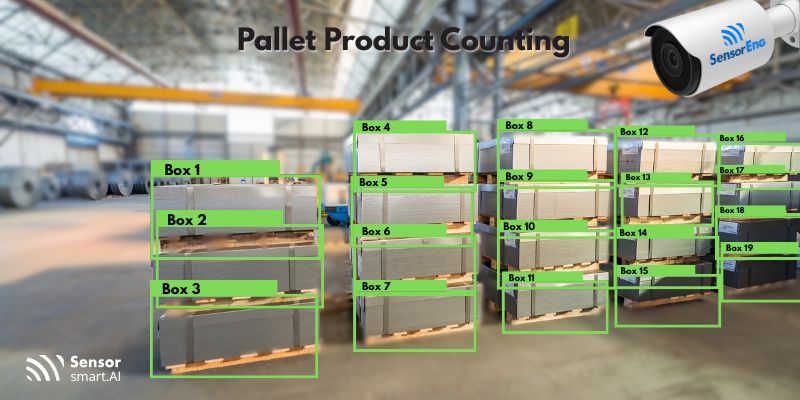
Computer vision, combined with AI, has proven to be a revolutionary advancement in the logistics sector. These systems can capture images or videos of pallets and automatically analyze characteristics such as shape, color, and size of items. One example is SensorEng’s solution, which leverages advanced cameras to analyze product batches in real-time, recording data with extremely low error rates. Solutions like this eliminate the need for manual counting and optimize large-scale inventory management.
2. RFID (Radio-Frequency Identification)
Another promising technology is RFID, which uses smart tags to automatically identify items stored on pallets. This technology enables simultaneous reading of multiple products without the need for physical contact, increasing the speed and accuracy of inventory control. For instance, ZetesMedea has developed a system that eliminates manual checks and achieves accuracy rates above 99.8%. Additionally, RFID is highly effective in dynamic industrial environments where products are constantly added or removed.
3. Automation with Drones and Mobile Readers
The adoption of drones and mobile readers is also on the rise. Equipped with cameras and sensors, these devices are capable of performing quick scans in large warehouses, capturing data in minutes. A practical example is seen in the case study of ID Logistics, a European company that implemented technology based on cameras mounted on moving forklifts, reducing the time spent on item counting by half.
 

International Case Study: ID Logistics

ID Logistics, one of the largest logistics companies in Europe, faced challenges with efficiency in pallet product counting within its operations. To address this issue, the company adopted an advanced automated system that combines cutting-edge technology with mobility. The system features a camera mounted on mobile forklifts, capable of operating with high precision even at speeds of up to 10 km/h.
The results were remarkable:
  • A 50% reduction in total inventory counting time.
  • Accuracy rates exceeding 99.8% in all counting processes.
This case study is a real-life example of the tangible benefits that automation can bring, whether in saving time or improving the reliability of processes.

Benefits of Automation in Pallet Product Counting

  • Optimization of Human Resources: Employees can focus on more strategic and less repetitive tasks.
  • Improved Customer Satisfaction: Accurate inventories allow orders to be fulfilled quickly and without errors.
  • Cost Reduction: With fewer mistakes, the company saves on issue resolution and waste.
  • Sustainability: Reducing paper usage in manual inventory processes is an indirect but highly relevant benefit.

Conclusion: The Future of Pallet Product Counting

Technological advancements in pallet product counting represent a significant milestone for logistics efficiency and inventory management. By leveraging tools such as AI, RFID, and drones, companies are reaching unprecedented levels of productivity and accuracy. Studies like the one conducted by ID Logistics emphasize that adopting these innovations is more than just a trend; it’s a strategic necessity for businesses aiming to stay competitive.
As these technologies continue to evolve, we can expect even more sophisticated systems, such as IoT integrations and predictive analytics, to be incorporated into the counting process. These advancements will further elevate operational standards of efficiency and reliability.

Leave A Comment