


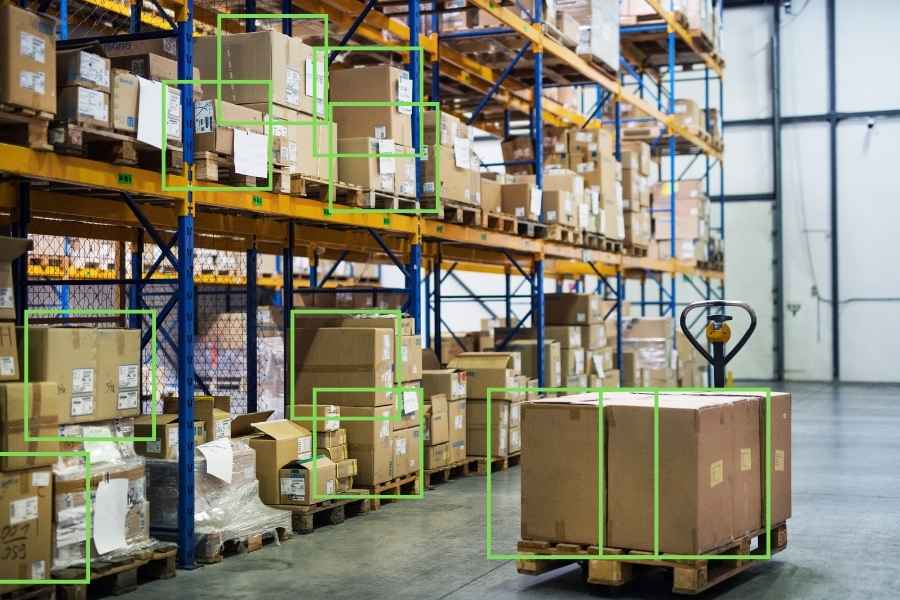
What is Product Counting on Pallets and Its Relationship with Inventory Control
Counting products on pallets consists of accurately quantifying and identifying the number of items grouped on pallets—structures made of wood, plastic, or metal used for transporting and storing goods. The choice of pallet type should take into account characteristics such as weight, product dimensions, and storage environment, with the standardization of this process greatly improving inventory control.
In inventory control, creating accurate lists of products allows the company to make informed decisions regarding restocking, sales, and promotional campaigns. With pallets, this task is facilitated by standardized storage, mechanized handling possibilities, and the application of technologies such as barcodes and automatic recognition systems.
Traditional Methods of Counting Products on Pallets — Limitations and Challenges
Historically, the counting process is manual, carried out by trained personnel who systematically check each item on the pallets. While effective for small volumes, manual counting faces serious problems in large-scale environments, such as:
Human Errors: Fatigue, haste, distraction, and adverse environmental conditions increase the likelihood of mistakes.
Cost and Time: The process can be slow, occupying valuable staff resources.
Safety Risks: The handling of heavy pallets may cause accidents if a safe, standardized process is not in place.
These disadvantages make automation and investment in new technologies increasingly attractive.
Robots equipped with sensors and artificial intelligence are capable of moving through aisles, identifying each pallet, and automatically performing the count, freeing up the human team for more strategic tasks.
International Study: Machine Learning for Pallet Detection and Tracking
A highlight in technological innovation is the international study entitled “Detection, localisation and tracking of pallets using machine learning techniques and 2D range data,” which proposes an artificial intelligence architecture to detect, locate, and track pallets in industrial environments. The system uses a Fast Convolutional Neural Network (Faster R-CNN), together with a CNN-based classifier for pallet identification, as well as a Kalman filter for tracking.
The results show that it is possible to identify and even track pallets in real-time, with robustness against false positives. This approach opens the door to even more reliable and intelligent automation of inventory control, especially useful for large distribution centers and high-volume industries.
Benefits of Accurate Product Counting on Pallets for Inventory Control
By investing in modern and precise counting processes for products packaged on pallets, companies see tangible results:
Reduction of losses and damage: Pallets enable safer handling, decreasing product damage.
Operational agility: Palletized inventory can be counted quickly, especially with the support of automated technologies.
Real-time tracking: The connection of readers, smart tags, and management software enables real-time inventory control, optimizing replenishments and avoiding stockouts.
Optimization of space and resources: Vertical stacking on pallets maximizes space usage and reduces logistics costs.
Fewer human errors: By minimizing manual interventions, counting errors are drastically reduced.
Implementation: Practical Tips for Industries and Distribution Centers
Standardized pallet selection: Choose formats and sizes compatible with your product mix and warehouse layout.
Identification technology: Implement barcodes or RFID on all pallets, integrating them into your management system.
Staff training: Provide regular training to ensure the team makes proper use of new solutions.
Continuous evaluation: Monitor indicators like accuracy, time spent, and incident rate to seek ongoing improvements.
Conclusion
Counting products on pallets is an efficient and increasingly indispensable strategy for inventory control in today’s competitive landscape. Investment in technology, combined with well-structured processes, enables cost reduction, space optimization, greater safety, and agility in the flow of goods. The highlighted international study shows that automation based on artificial intelligence is consolidating as a competitive differentiator for companies concerned with logistics efficiency.
The search for perfect inventory control must be constant, and the evolution of available solutions requires attention and adaptation: standardize, invest, train, and constantly monitor. This way, your business will be ready to achieve the highest levels of performance in inventory management.