


Introduction
The modern industrial scenario is marked by an unceasing pursuit of greater productivity, less waste, and superior quality. In this context, a factor of extreme relevance for the success of operations sometimes ends up being neglected: the precise counting of objects on production lines. At first glance, this activity may seem simple, but it is fundamental to ensure Production Line Efficiency, directly impacting quality control, logistics, and production planning.
With the rise of solutions based on Artificial Intelligence (AI) and Computer Vision, the limits imposed by manual counting have been left behind, giving way to automated methods that combine speed, precision, and reliability. This article explores the strategic importance of automated object counting, highlighting international studies and showing how it integrates into the concept of Industry 4.0.
Why Is Object Counting Crucial for Production Line Efficiency?
Production Line Efficiency presupposes optimal use of resources, minimal rework, and total customer satisfaction. For this, it is essential to know exactly how many products are being processed at each stage any inaccuracy can generate stock ruptures or improper deliveries, negatively impacting costs and the company’s reputation.
When counting is performed manually, repetitiveness can lead to operator fatigue, increasing the risk of errors. Each failure, no matter how minor, propagates along the production flow, creating a chain of problems: excess or shortage of products, need for rework, delays, and even waste of raw materials.
Limitations of Traditional Methods and the Role of Technology
Historically, the manual method was predominant in object counting. Dedicated operators checked parts one by one a common scenario, but marked by failures, slowness, and high operational cost. With today’s market demands, the margin for error has become minimal. The time dedicated to manual counting could be used for more strategic functions, further contributing to Production Line Efficiency.
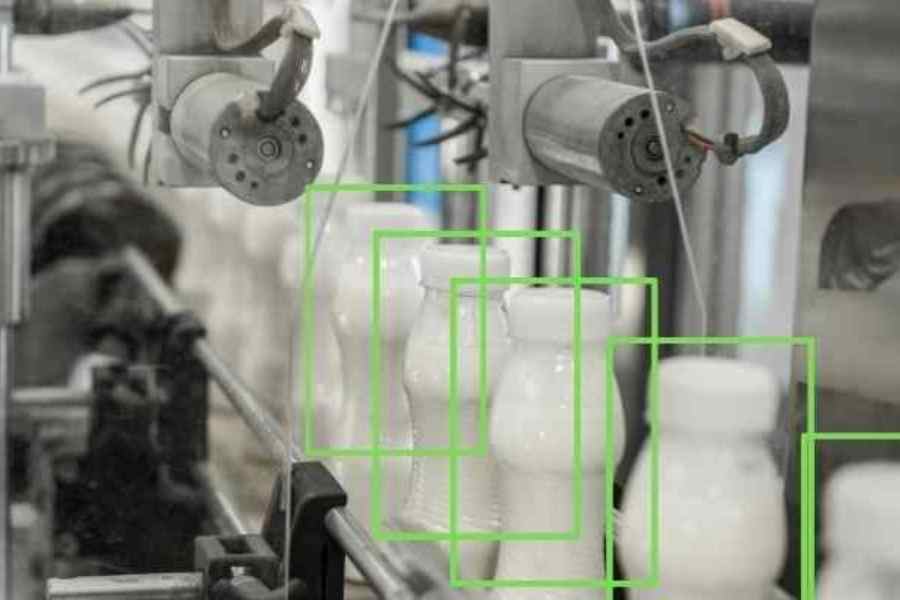
Here is where technology stands out: Computer Vision and AI systems, through cameras, sensors, and advanced algorithms, allow for the identification and automatic counting of objects in real-time, drastically reducing the incidence of human errors.
An example is the study “An Image Processing based Object Counting Approach for Machine Vision Application,” which presents a methodology using Otsu’s thresholding and Hough transform. This solution demonstrated fast, accurate, and reliable results, capable of counting objects of different types and colors, standing out for its robustness in the face of factory environment challenges.
Benefits of Automated Counting for Production Line Efficiency
Cost Reduction — By eliminating human errors and rework, resource wastage and the need for manual inspection are reduced, optimizing operational costs.
Productivity Increase — The automated process is much faster, allowing the production line to operate at higher speeds without sacrificing accuracy.
Assured Quality — Accurate counting ensures each product receives the exact components, minimizing assembly defects and improving quality control.
Optimized Inventory Management — The integration of automated counting with ERP systems provides real-time information, allowing for immediate adjustments in production and supply.
Customer Satisfaction — Correct and on-time deliveries are a direct result of counting accuracy, reducing returns and improving the company’s market image.
Additionally, as cited in relevant articles, the International Federation of Robotics (IFR) has identified that the adoption of automation technologies, including automated counting, can increase production line productivity by up to 30%.
International Case Study: Artificial Intelligence in Industry
A notable empirical study was developed by researchers in the article “Capacity Constraint Analysis Using Object Detection for Smart Manufacturing,” in which a model based on convolutional neural networks was applied to identify and track objects on the industrial production line. The system acted not only in counting but also in the analysis of capacity constraints, automatically identifying less productive stations and directing interventions for optimization. The gains resulted in measurable increases in efficiency, reduced bottlenecks, and substantial improvements in the production process.
Object Counting and the Universe of Industry 4.0
Automated object counting is a cornerstone of the Industry 4.0 concept, in which integration, automation, and data analysis are central elements. When combined with ERP systems and smart sensors, this technology enables real-time visualization of production, immediate action on deviations, and decision-making based on accurate data.
These innovations contribute to a more resilient industrial culture, capable of quickly adapting to the demands of the global market and maintaining high standards of competitiveness.
Conclusion
Accurate object counting goes beyond an operational role and establishes itself as strategic for Production Line Efficiency. Its automation is the safest and most effective path to eliminate failures, increase productivity, reduce costs, and ensure operational excellence. Investing in Computer Vision and AI technologies, combined with integrated management, is to incorporate the logic of Industry 4.0 at the heart of the production process.