


Introduction
In a world increasingly focused on automation and technological innovation, workplace safety has gained a new ally: the automated detection of Personal Protective Equipment (PPE). Safety control is essential not only for the physical integrity of workers but also for compliance with legal standards, productivity, and the reduction of costs related to accidents. However, individually monitoring the correct use of PPE in dynamic environments with many employees has always been a considerable challenge. That is why intelligent detection systems are emerging as key players in the modernization of safety control in organizations of all sizes.
Safety Control: The Fundamental Role of PPE
Safety control involves policies, technologies, and procedures aimed at reducing occupational risks, and the correct use of PPE is one of its main pillars. Helmets, gloves, protective glasses, boots, and reflective vests are classic examples that make up the frontline defense for workers against accidents.
However, studies indicate that manual inspection whether performed by supervisors or inspectors has its weaknesses: susceptibility to human error, lack of coverage in remote or busy areas, as well as the high cost of maintaining teams dedicated solely to this purpose. In this scenario, the implementation of automated PPE detection systems stands out as a solution capable of optimizing safety control, bringing gains in efficiency, traceability, and accuracy.
Computer Vision and Artificial Intelligence: The New Era of Inspection
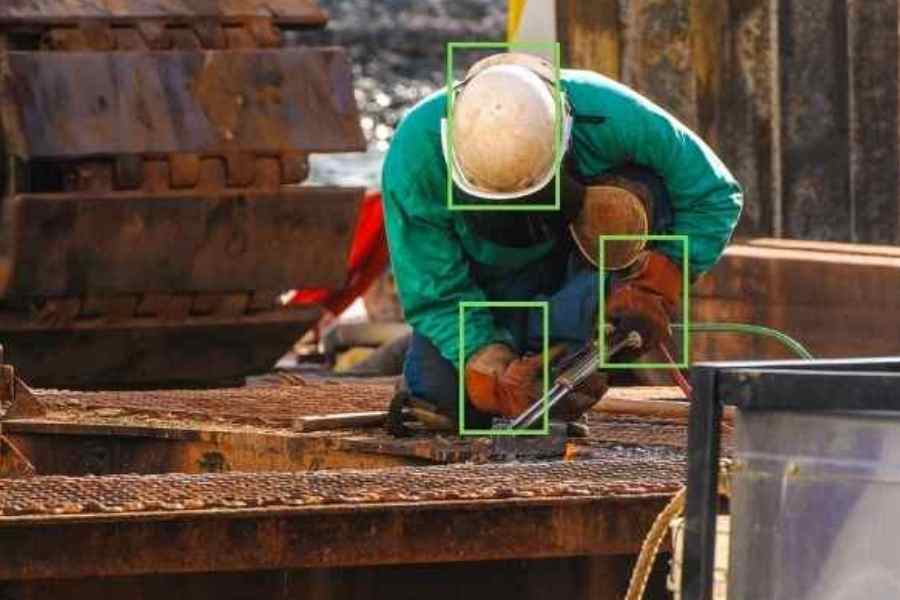
Modern solutions use computer vision algorithms and artificial intelligence (AI) together with cameras strategically distributed throughout the workplace. These sensors capture images and videos, which are processed by software capable of identifying in real time whether the worker is or is not wearing all the PPE required for that specific activity or location.
According to the international study “Visual Detection of Personal Protective Equipment and Safety Gear on Industry Workers,” automated detection systems can recognize PPE such as helmets, vests, gloves, glasses, and ear protectors, reaching accuracy rates of 99% at a distance of 3 meters and 89% even at 5 meters quite high levels that reinforce the reliability of this solution.
These systems, besides continuously monitoring, can be integrated with access control gates, allowing entry only to those who are properly protected raising the standard of safety control.
Another study, “SuPEr-SAM: Using the Supervision Signal from a Pose Estimator to Train a Spatial Attention Module for Personal Protective Equipment Recognition,” describes methodologies that use body detection and human pose estimation, allowing algorithms to be even more efficient by focusing directly on body locations that typically use PPE, without overloading processing systems.
The use of deep learning ensures adaptation and customization to different environments and accessories, making safety control highly flexible and effective.
Practical Benefits of Automated Detection in Safety Control
Real-time detection and immediate intervention: Technology enables the sending of instant alerts in cases of absence, incorrect use, or poor maintenance of PPE. This allows supervisors and managers to quickly respond to risk situations, preventing accidents before they occur.
Guaranteed regulatory compliance: Companies gain a powerful ally in meeting and proving compliance with regulatory requirements (national and international), minimizing the risk of fines, shutdowns, or lawsuits.
Reduction of financial and operational costs: Preventing accidents reduces costs with absences, compensation, and medical treatments, as well as maintaining a high level of productivity. Additionally, automated monitoring frees up human teams for other strategic tasks, optimizing internal resources.
Data analysis and tracking: The systems record all occurrences, enabling qualitative and quantitative analysis, identification of non-compliance patterns, and the implementation of preventive action plans based on real data.
Education and awareness: Monitored environments encourage greater discipline and attention from workers, strengthening the organizational safety culture.
Safety Control Under International Light
The importance of AI in occupational safety is highlighted by international studies, including a survey from the European Agency for Safety and Health at Work (EU-OSHA). The report reinforces that AI can monitor, analyze, and predict risks, as well as ensure real-time interventions to prevent accidents. It also recommends the development of ethical policies to ensure privacy, transparency, and respect for workers crucial points for the success and acceptance of these technologies.
Challenges and Ethical Considerations
Although technological advancements have raised the level of safety control, there are obstacles to consider:
Equipment variations: Different PPE models, lighting conditions, and worker positions can interfere with accuracy, but techniques such as data augmentation and algorithm adjustment help mitigate some of these challenges.
Privacy and ethics: Continuous monitoring raises privacy discussions. It is essential to ensure transparent policies, ethical use, and clear communication of the system’s objectives and limits.
Initial investment: The acquisition and implementation cost may be high, especially for small businesses, but the return is assured through reduced accidents and increased productivity.
Conclusion
Automated detection of PPE usage is revolutionizing safety control in industry and other sectors. The integration of artificial intelligence and computer vision enables a new level of efficiency and prevention, making it an indispensable tool for companies committed to the well-being of their professionals. More than a trend, it is a strategic necessity for a safe, productive work environment that complies with all regulations.